
Your complete electrical partner, from concept to high voltage.
Precision Engineering Behind Every Electrical Work, From Residential to Mega-Scale.
Bakit Magkakaiba ang Singil sa Pangasinan? The Generation Mix Behind Every Electric Coop
Same province, same heat. But last January, one utility in Pangasinan was charging ₱7.34 per kWh while another was charging ₱11.80. The towns are just right beside each other, but the difference in rates is really big.
Every electric utility buys power from different power suppliers — through contracts or from the spot market. The mix of these sources is called the generation mix, and it's the biggest reason why rates differ kahit magkakatabi lang ang mga bayan.
Video Credit: Bilyonaryo News Channel
What's Inside the Rate per kWh?
The rate you pay has two big parts:
- Generation charge — the price of power from the power plants. This is the biggest part: in September 2026, around 50% to 60% of the total rate across the four utilities in Pangasinan.
- Other charges — transmission (carrying power through the big lines), system loss, the utility's distribution, metering, subsidies, and taxes.
So when the generation charge moves, the whole bill moves.
Each Utility's Generation Mix (2026)
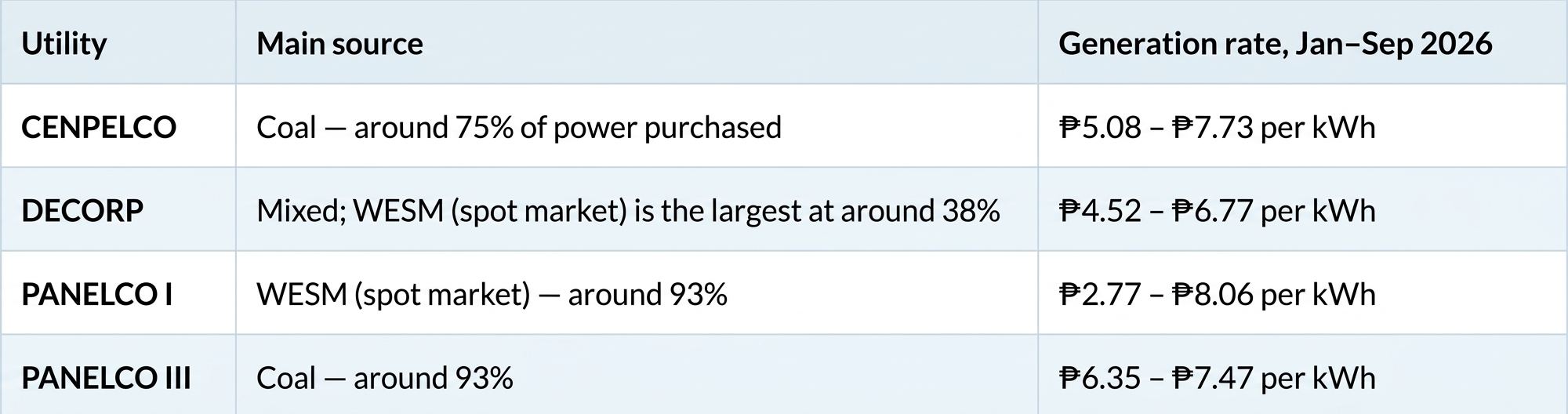
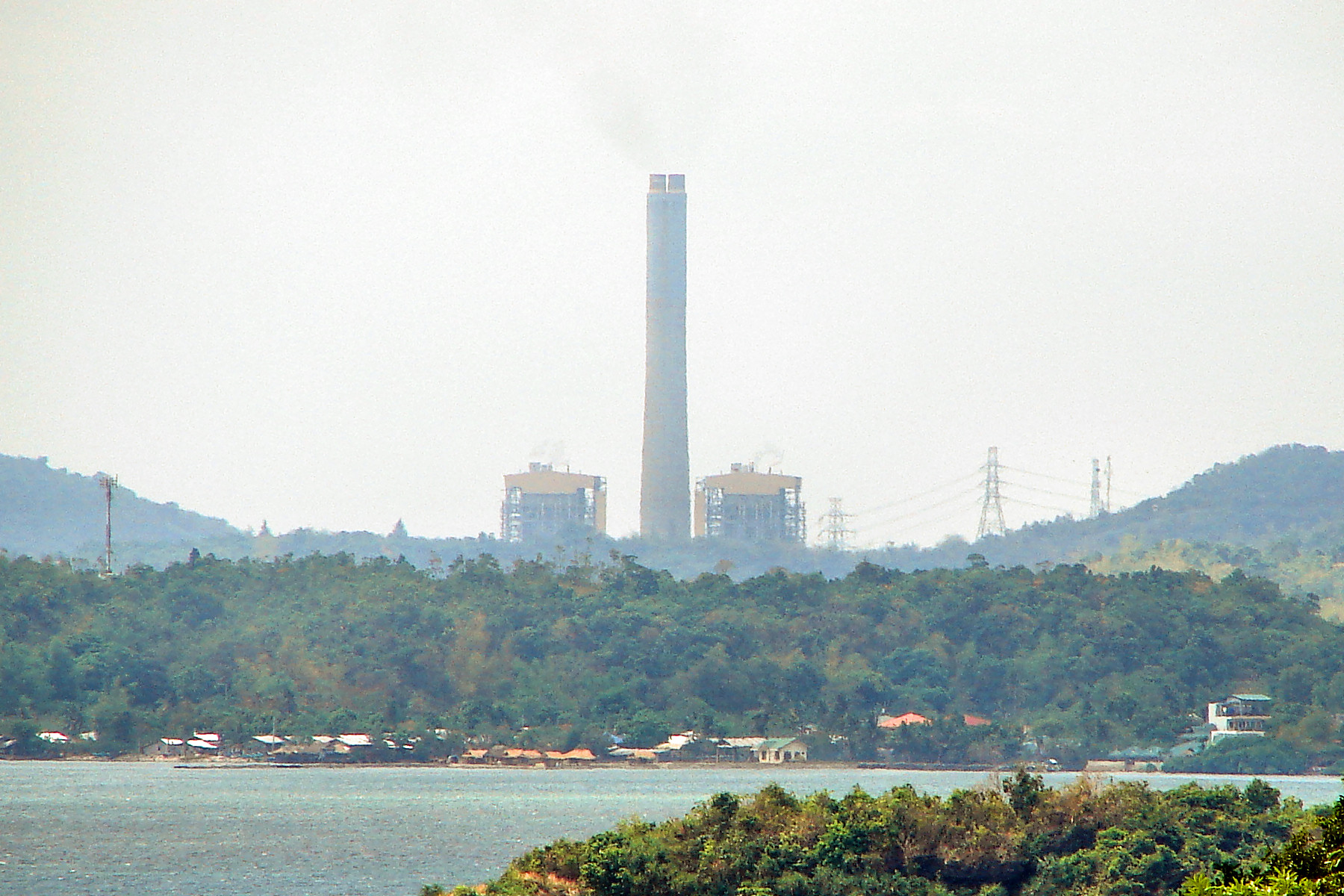
Contract vs. Spot Market: The Big Difference
The way a utility buys its power shapes how its rate behaves from month to month:
- Contract (Power Supply Agreement): This works like a regular supplier (suki) at the market, with an agreed price and volume of power for several years. The rate is more stable, but it does not drop right away even when market power is cheap. That is why PANELCO III (around 93% coal) stayed within a ₱6.35 to ₱7.47 generation rate for the whole of 2026.
- WESM (Wholesale Electricity Spot Market): This works like market prices that change every day (araw-araw), sometimes very cheap and sometimes very expensive, depending on supply and demand. PANELCO I, with around 93% sourced from WESM, had a generation rate of ₱2.77 in March but ₱8.06 in July, almost three times higher.
There is also important context for 2026. A national energy emergency was declared because of tensions in the Middle East. The ERC suspended WESM on March 26, 2026 and used a temporary pricing mechanism, and normal operations resumed on May 1, 2026. Hindi ito simpleng galaw ng merkado; malaki ang epekto ng mga pangyayaring ito sa singil.
Video Credit: One News PH
3 Critical Steps to Avoid Surprises on Your Bill
Staying ahead of rate changes requires a mix of awareness and action:
1. Check the Generation Charge Every Month
This is the biggest part of your bill. Kung tumaas ito, your whole bill will likely go up even if your consumption did not change.
2. Cut the kWh You Buy
You cannot control the price, pero kaya mong kontrolin ang dami.
3. Make Your Own Generation
Rooftop solar is like having your own contract whose price does not move: every kWh your panels produce is a kWh you no longer buy from the coop.
This educational guide is brought to you by Lumenova Philippines as part of our ongoing public awareness campaign for safer Filipino homes and compliant electrical engineering practices.
Safe, Smart, Certified
Electrical Solutions
for the Philippines
Gusto Mo Bang Mag-Solar Nang Walang Nilalabas na Cash?
- 💸 Walang Cash Limit at 0% DP – Large home? Multiple aircons? No problem. Get funded for any system size through our partner banks with ₱0 upfront cost. Kami ang mag-aasikaso ng requirements.
- 🛡️ May Kasamang Fire Insurance – Zero anxiety over accidents or damage. Your investment is protected from day one with built-in Fire Insurance coverage verified by our certified engineering team.
- 📉 Start Saving on Electricity – Drastically drop your monthly bills the moment your system turns on. Run your household appliances guilt-free.
- 🔌 Kumita sa Grid (Net Metering) – Turn your roof into a money-maker. Sell your excess solar electricity back to the grid to earn direct bill credits.
Slash Operating Costs with Clean Energy
- 💸 0% DP, No Cash Limits – Capitalize on Unlimited Bank Financing with ₱0 Down Payment. We handle 100% of the bank paperwork and approvals.
- 📉 Massive Opex Savings – Cut your commercial peak electricity costs by up to 70% from day one. Run your operations and ACs guilt-free.
- 🛡️ Built-In Fire Insurance & Top Tech – Maximized safety and asset protection using smart microinverters, rapid-shutdown tools, and certified Fire Insurance coverage.
- 🔌 Turnkey Installation & Net Metering – Complete, hassle-free handling from engineering design to automated Net Metering utility connection. Kami ang mag-aasikaso.
Certified Blueprints & Precision Calculations
- 🛡️ Built-In Fire Insurance – Total liability protection from day one. Every commercial installation is backed by comprehensive Fire Insurance coverage verified by our engineering team.
- 🛡️ 100% PEC Compliance – Receive official blueprints, load calculations, and Single-Line Diagrams (SLD) ready for smooth LGU building permits and utility grid connection.
- ⚡ Advanced Safety Analytics – Complete protection with full arc-flash and short-circuit testing to safeguard your facility and qualify for built-in Fire Insurance.
- 🏗️ Expert Oversight – Fully engineered and managed by veteran solar professionals with international mega-project experience.
Complete Electrical Work
from Concept to High Voltage
- 🏗️ Full Build-Outs & Equipment – Full-scale wiring infrastructure, heavy equipment supply, custom safety enclosures, and strict PEC-compliant engineering.
- 🔬 Rigorous System Testing – Complete safety inspections, arc-flash analytics, and rigorous commissioning before final handover.
- 🔋 Future-Ready Integration – End-to-end setups engineered for modern EV charging stations and smart grid integrations.